
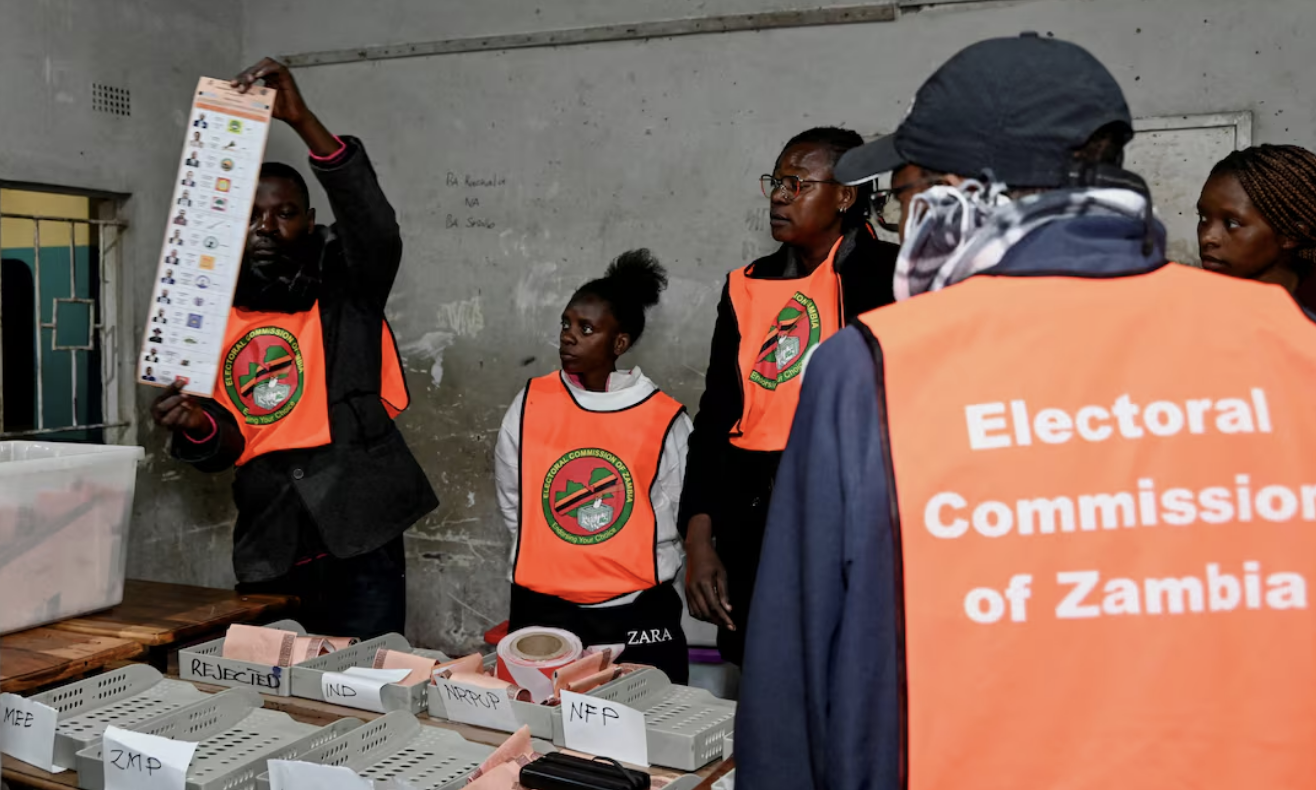
Zambia will need deliberate reforms to strengthen key oversight institutions to restore public trust ahead of the 2031 elections, participants said during Zambia After the Ballot, a recent online discussion convened by the Resistance Bureau.
The discussion followed the swearing in of Zambia's President Hakainde Hichilema for a second five-year term on September 1 after garnering 60% of the vote, according to official results. His main challenger Brian Mundubile, who received 38%, alleged that the outcome had been tampered with.
During the discussion, panelists argued that as the dust from the polls settles, the verdict is clear: with 40 percent of the electorate dissatisfied, Zambia needs a different conversation. Not a debate about who won or who gets what seats, but a deeper reckoning about how to address what came out of this election and correct the mistaken assumption that political culture automatically changes once a ruling party is removed and the opposition wins.
While Zambia's democratic foundations remain intact and the voting process was predominantly peaceful, the need for effective remedies through key oversight institutions — notably the Human Rights Commission, the Police, and the Judiciary — remains pressing, participants said.
Proposed reforms included publishing electoral data at polling-station level, preserving electoral records, respecting court processes, avoiding premature declarations of victory and publishing the basis of any parallel tabulation. They also included disclosing campaign financing, preventing political violence, protecting digital information integrity and carrying out periodic public audits of electoral preparedness.
One of the panelists, Zambia Human Rights Commission Chairperson Dr Pamela Sambo said the Commission monitored the elections before, during and after, and found that "predominantly voting was peaceful in most parts of the country." "Overall, the country's democratic foundations remain intact and strong but there is an urgent call for ensuring that there is accountability," she said.
Sambo said some restrictions affected political mobilisation, participation, and the broader civic space. She said among the Commission's most serious concerns were prolonged arrests and detentions, as well as a "failure to heed the call for due process."
She placed the current concerns in context as a long-standing systemic challenge within Zambia’s criminal justice system, rather than a new post-election development, and underscored the need for reforms to strengthen due process and judicial oversight ahead of the next elections slated for 2031.
Sambo explained that the Commission's work has been difficult throughout this year and in previous years when it confronts "cases of prolonged detention and a failure to adhere to due process." "What we have seen in this regard is that the electoral period has also heightened this already existing problem," she said.
A veteran journalist, Charles Mafa said President Hichilema clearly won a second term, but determining who emerged victorious does not settle the bigger democratic questions raised by the entire process.
Independent verification of the 2026 election results has reinforced the credibility of the Electoral Commission of Zambia's count, while flagging isolated procedural issues for reform ahead of 2031.Mafa, for his part, cited Transparency International-Zambia's (TIZ) voting tally. "Organizations like TIZ found that the overall difference between ECZ announced results and those documented by its monitors was relatively small, approximately 1.1% difference, but it nevertheless identified procedural concerns in 32 constituencies."
This finding is critical context. The small variance confirms the ECZ outcome broadly reflected the ballots cast and concerns in 32 constituencies out of 156 do not overturn the national picture but rather point to administrative improvements that are needed.
"Yes, we can accept that results and still question the process. That is very important. Questioning aspects of the electoral process does not automatically mean that we are rejecting the results. Equally accepting the fact that President Hichilema was announced winner does not mean that everything that happened during the election should escape scrutiny," said Mafa.
He added that police conduct concerns have been raised, “regardless of which political party is in government,” pointing again to a long-standing structural reform agenda rather than a 2026-specific failure.
The panel discussion came against a backdrop of contested post-election incidents.
Within 24 hours of the polls closing, security forces raided a property linked to Mundubile where former minister Mutotwe Kafwaya was killed and 11 opposition figures arrested. Mundubile and others now face treason charges. His Tonse-Pamodzi Alliance failed to file an official challenge after courts were sealed for “security reasons,” following a brief suspension of counting due to polling station violence on election day.
On September 11, the government also revoked citizenship of six critics, including blogger Lillian Mutambo and academic Sishuwa Sishuwa, once again citing vague “national security” concerns.
A joint statement issued on 16 September by lawyers' associations—including the Law Society of England and Wales (LSEW), International Commission of Jurists (ICJ), and Pan African Lawyers' Union (PALU)—said these recent actions undermine the rule of law in Zambia, as they narrow civic space, severely limit access to justice, and erode the separation of powers.
“They appear to be in violation of domestic Constitutional guarantees, as well as several international obligations and standards applicable to Zambia," the statement said.
To remedy the situation, the lawyers urged the Zambian government to conduct independent, impartial and effective investigations into the killing of Mutotwe Kafwaya; establish an independent and transparent inquiry into the legality of the closure of the courts in August 2026 to ensure litigants are not prejudiced by the closure of the courts; and to restore the cancelled passports pending a fair and transparent process.
In response, the Zambian government issued a statement saying there was no breakdown in the rule of law. "The Republic is a constitutional democracy governed by the Constitution and the laws enacted under it,” it said. “In that regard, Government remains strongly committed to the rule of law, the separation of powers, respect for fundamental human rights, among others."
Clemence Manyukwe is an independent Zimbabwean journalist. Follow him on Twitter: @charindapanze01
Disclaimer: The views expressed in this publication do not necessarily reflect the views of Vanguard Africa, the Vanguard Africa Foundation, or its staff.