
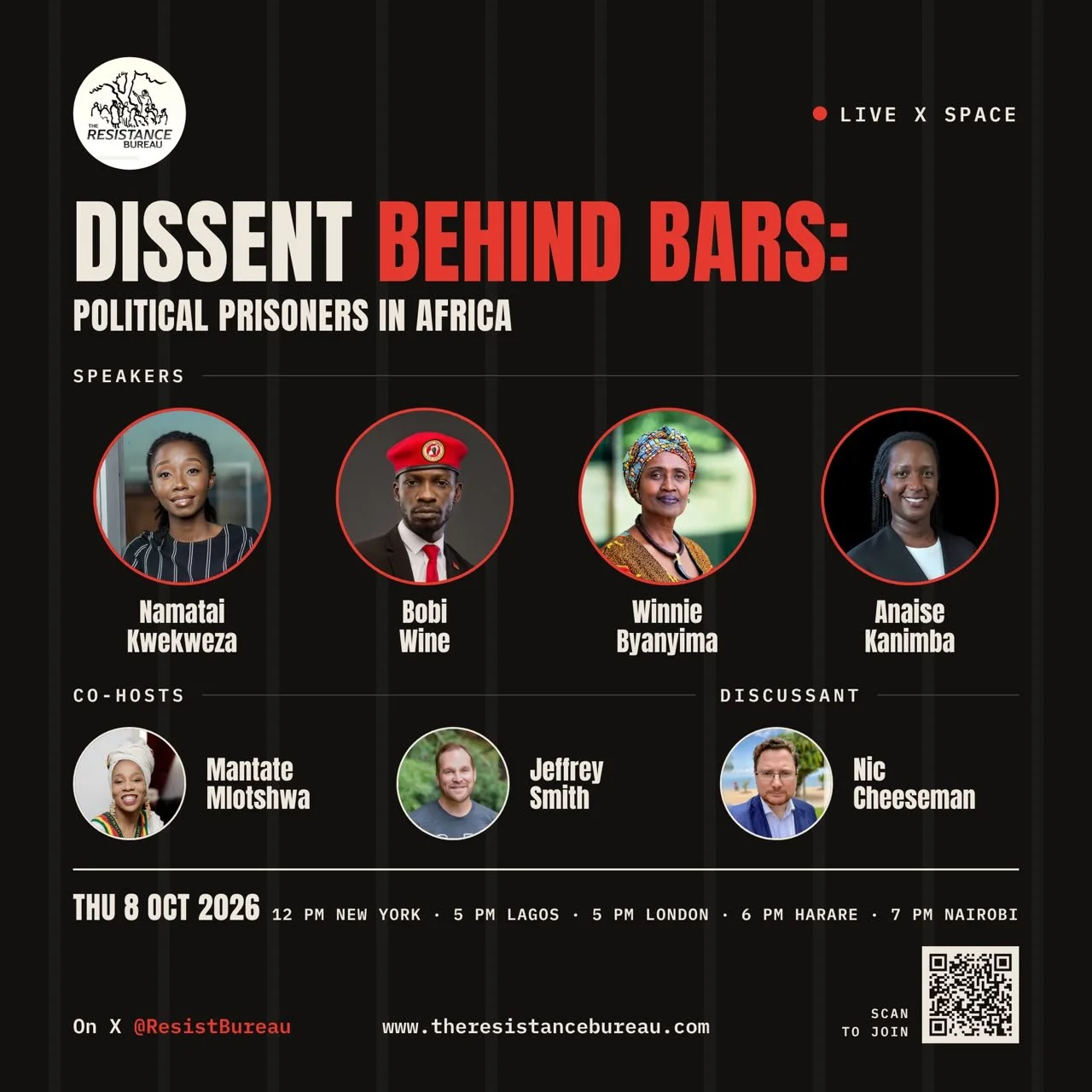
When Zimbabwean human rights activist Namatai Kwekweza boarded a domestic flight to Victoria Falls on July 31, 2024, to attend the African Philanthropy Conference, she did not expect the plane to be grounded before it left Harare. Minutes after the pilot announced that airport security had grounded the flight, state agents boarded the aircraft and ordered her and three others off. “I was being difficult intentionally to buy time because I needed to text my emergency contacts,” Kwekweza recounted during a recent Resistance Bureau X Space titled ‘Dissent Behind Bars.’
What followed, her lawyers would later say, was severe mistreatment. She was handed over to police and spent weeks in detention before being granted bail—a pattern familiar to many victims of state torture and legal persecution in Zimbabwe.
Kwekweza said her experience as a political prisoner was not isolated. “When we have these conversations about political prisoners in Africa, I think we have to see it as a global problem,” she said. “We are living at a very dark moment in human history. Over 80% of the world’s population is living under some type of autocracy.”
The pattern, she argued, is deliberate. “It’s a systemic blueprint that you can trace from Moscow to Nairobi to Harare... those individuals who enforce the systems actually exchange notes,” she said.
Also speaking in the Space were Ugandan opposition leader Bobi Wine; Winnie Byanyima, wife of veteran Ugandan opposition leader Dr. Kizza Besigye, who is currently jailed and facing treason charges in a military court; and Anaise Kanimba, daughter of Rwandan former political prisoner Paul Rusesabagina, whose sheltering of more than 1,200 people during the 1994 Rwandan genocide inspired the film Hotel Rwanda.
Abduction as State Policy
The authoritarian blueprint was evident in the accounts shared across the panel.
Bobi Wine—speaking from exile in the United States, where he has lived since March 2026 following Uganda’s disputed January election—said he had lost count of how many times he had been arrested and tortured. He also said he had lost count of how many friends he had seen shot dead or run over by police or military trucks.
His personal driver and longtime friend, for example, was shot and killed during a raid by the Special Forces Command, which is led by President Museveni’s son.
After the 2026 election, Wine fled following a raid on his home. “My wife was later tortured, humiliated, photographed,” he said, adding that the images were later shared online by Ugandan officials. “What is happening in Uganda is a reign of terror. A reign of terror where people are picked and tortured publicly.”
Speaking about her father’s imprisonment in Rwanda, Anaise Kanimba described being barred from visiting him while he spent 11 months in solitary confinement. “We were able to have the privilege of a phone call with him once a week... when we spoke with my father, we knew we were being surveilled,” she said. “We had to speak in proverbs... the fear of not knowing how he’s doing, not being able to see him, to touch him... he was sick, he could not see doctors. And the agony that you have, not knowing that you will ever see him again.”
Rusesabagina now lives in the United States following his negotiated release in 2023, when his 25-year terrorism sentence was commuted.
The case of Winnie Byanyima’s husband, Kizza Besigye, illustrated another cross-border tactic. As Byanyima and other contributors noted, Besigye was abducted in Nairobi, Kenya, and driven to military barracks in Kampala. Liberatus Mwang’ombe, a Tanzanian governance and social justice advocate, highlighted the case of Tanzanian opposition leader Tundu Lissu, who faces treason charges, as well as those of dozens of his party colleagues held on terrorism charges. Lissu’s case in particular, he said—he was arrested eight times between 2016 and 2017 for criticizing authorities before being shot 17 times in an assassination attempt—shows that arrest alone is often not enough. He drew parallels with Besigye, who also faces treason charges in Uganda.
“These political prisoners who are behind bars, who have been arrested, and those who have been abducted... this constitutes transnational repression,” he said.
From the audience, human rights activist and journalist Denise Zaneza highlighted the case of Rwandan opposition leader Victoire Ingabire. Zaneza said the similarities in state repression make it imperative for everyone defending democracy, human rights, and political freedoms to support one another across borders, not just in their own countries. She noted that the Rwandan government brands such solidarity as ‘foreign interference,’ but countered that “sovereignty is not a license to violate fundamental human rights.”
“Authoritarian regimes, we see it all around the world, they have similar tactics to silence dissent—intimidations, retaliations, prosecutions—and they manipulate the system, the justice system,” she said. “It is precisely why I think our solidarity must also go beyond borders.”
The Antidote: Grassroots Solidarity
If autocrats share a blueprint, the panel concluded, democrats must mount an equally united and robust response. Bobi Wine closed with a call for unity that directly answered Kwekweza’s opening warning and Zaneza’s appeal.
“Autocrats are united and they look out for one another,” he said. “Those of us who want democracy and human rights, we must work twice as hard... Injustice anywhere is a threat to justice everywhere.”
Clemence Manyukwe is an independent Zimbabwean journalist. Follow him on X: @charindapanze01
Disclaimer: The views expressed in this publication do not necessarily reflect the views of Vanguard Africa, the Vanguard Africa Foundation, or its staff.