No Alibi for a Massacre
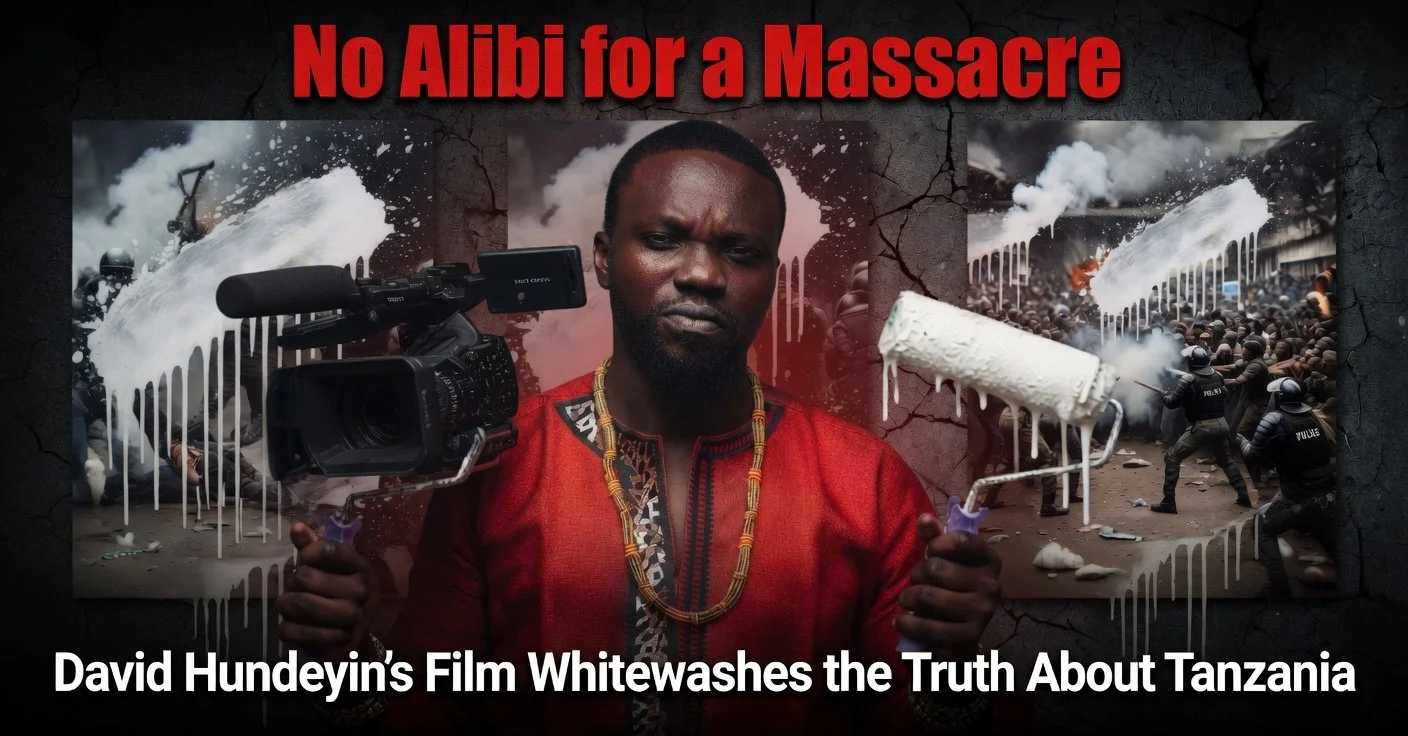
The central question raised by What Happened on October 29?—a self-described documentary by Nigerian blogger David Hundeyin—is not whether media narratives should be scrutinized; they absolutely should. The real question is whether his particular brand of scrutiny is being weaponized to blur Tanzania’s well-documented record of abuse and state violence, and in doing so to gaslight victims, survivors, and the broader public.
Hundeyin’s film presents itself as a corrective to international coverage of the nationwide unrest that followed Tanzania’s October 2025 election, in which President Samia Suluhu Hassan’s ruling Chama Cha Mapinduzi (CCM) was credited with nearly 98 percent of the vote. But any credible account of that period must begin with what independent observers have firmly established: the poll was deeply flawed, and the state’s response to protests was brutal, callous, and characterized by brazen impunity. Choosing to narrate around those facts is not skepticism. It is the height of political gaslighting.
The African Union (AU) election observation mission concluded that the vote did not comply with minimal democratic standards, while the Southern African Development Community (SADC) said voters could not freely express their democratic will. In the days that followed the election, Tanzanian security forces repeatedly used live ammunition, tear gas, mass arrests, and an internet blackout to suppress popular dissent. That is the essential record. Any account that pushes those facts to the margins weakens, rather than strengthens, the search for truth.
What transpired after Tanzania’s rigged election is not in dispute, even if exact casualty figures remain difficult to ascertain due to state censorship, intimidation, and the deliberate removal of bodies. Amnesty International reported that security forces used unnecessary and disproportionate force between 29 October and 3 November 2025, firing live ammunition directly at protesters and innocent bystanders, injuring and killing large numbers of people, including children. Likewise, the UN human rights office said it received credible and scrupulously fact-checked reports of hundreds killed, enforced disappearances, and arbitrary detentions. Later on, UN experts also described widespread and systematic human rights violations and cited estimates of at least 700 extrajudicial killings. Human Rights Watch, local civil-society groups, and regional observers have all described a crackdown marked by lethal force, media restrictions, and obstruction of accountability. Reports that bodies were removed from the streets, hospitals, and mortuaries—and taken to undisclosed locations—are especially grave. Such actions suggest not only unlawful killings, but a deliberate and systematic attempt by state officials to conceal the evidence of a massacre.
Responsible journalism does not require exaggeration. It requires precision: peaceful dissent in Tanzania was met with crushing force on a scale that demands, at a minimum, independent investigations and justice for the many victims and their grieving families.
That is why the effort by Hundeyin and his associates to recast a horrific episode primarily as a story of foreign manipulation is dangerous. Outside actors can indeed shape information environments, and media coverage can be incomplete or uneven—especially in Africa. But none of that erases the documented conduct of Tanzanian authorities. When a film spotlights alleged ‘external plots’ while sidelining exhaustive evidence from victims, local human rights groups, and international monitors, it redirects attention away from state responsibility. It encourages audiences to treat atrocity reporting as mere propaganda, to view accountability as a foreign agenda rather than a legal and moral necessity, and ultimately to gaslight the bereaved by suggesting that what they saw, endured, and lost is somehow less real than an ideological storyline.
For human rights advocates in Tanzania, and in other authoritarian contexts around the world, the pattern is familiar: repression is protected not only by lethal force, but by narrative laundering, whitewashing, and gaslighting. Facts are muddied, witnesses are discredited and smeared, and the demands for justice and accountability are recast as attacks on sovereignty. Journalism should test all claims, including those made by the mainstream media. But it also has a duty to confront power honestly, regardless of who occupies the presidential palace.
Hundeyin’s cynical framing in this propaganda reel—masquerading as a legitimate documentary—is not an isolated lapse. It fits an established pattern in which he has publicly cast military juntas and extended undemocratic rule in West Africa and the Sahel as principled expressions of sovereignty, rather than what they are: illegal power grabs and an ominous departure from constitutional order. In published commentary and interviews, he has argued against elections in Mali, Niger, and Burkina Faso, praised the tyrannical trajectory of the Alliance of Sahel States, and portrayed democratic demands as little more than externally imposed ritual. That record matters because it suggests that the minimization of abuses in Tanzania is not an aberration, but part of a broader habit of laundering authoritarian power through the language of anti-imperial sophistication.
Put simply: any account that downplays credible and overwhelming evidence of state repression for the sake of geopolitical posturing, or a crude anti-Western performance, does not simply distort the truth—it helps powerful abusers conceal the suffering they have inflicted. And this, of course, matters far beyond one filmmaker or one film. The issue is whether Tanzanians who were killed, disappeared, tortured, or arbitrarily detained after a contested election will be remembered as rights-bearing citizens or callously dismissed as collateral damage in an ideological quarrel.
As I understand it, Pan-Africanism is not the reflexive defense of a government that speaks the language of sovereignty. It is solidarity with African people, especially when their own governments deny them dignity, voice, and life. The rights at stake here—the right to participate in a credible election process, to assemble peacefully, to speak freely, and to live without fear of disappearance or execution—are not foreign concepts or impositions. These are universal guarantees. They are affirmed in the African Charter on Human and Peoples’ Rights (ACHPR) and in the many democratic commitments African states have made to one another.
That is why Tanzanian authorities must allow a truly independent investigation, reveal the fate of the hundreds still missing, return the dead to their families, free those still arbitrarily detained, and hold every perpetrator to account. Journalists, advocates, citizens—and yes, documentary filmmakers—should demand nothing less. No film, however polished or artfully spun, can outrun the truth: grave abuses were committed on a large scale before, during, and after Tanzania’s 2025 election charade. That truth lives on—in memory, in scar tissue, and in the unrelenting grief of a nation.
The test now is whether the region—and the wider world, in genuine solidarity with the Tanzanian people—will demand truth and justice or stand by while yet another state massacre is laundered, gaslit, and buried beneath silence. What is at stake is not only memory, but moral clarity: whether the dead will be named, whether the disappeared will be counted, and whether the living will be told that their suffering was real, that it mattered, and that it cannot be erased.
Jeffrey Smith is the founding director of Vanguard Africa and the Vanguard Africa Foundation, as well as the co-founder and producer of The Resistance Bureau.