
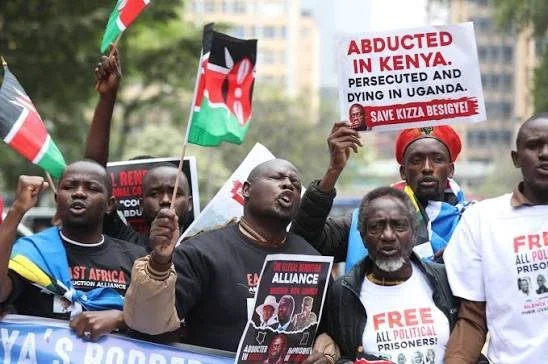
On 25 October, Tanzanian opposition activist Twaha Mwaipaya was travelling in a taxi to visit friends in Kamulu, Machakos County, when three vehicles blocked the road and he was taken away.
His whereabouts remain unknown.
Former Chief Justice David Maraga and Amnesty International Kenya have both demanded that Kenyan authorities immediately establish his whereabouts, guarantee his safety, and investigate his disappearance. But Mwaipaya is not an isolated case.
In a statement, Maraga said that, for many years, Nairobi was a safe place for people fleeing repression at home and refugees escaping war, but that this is no longer the case. He said that Kenya is increasingly becoming an ‘abductors' paradise’ and an East African centre for transnational repression.
"The abduction of Ugandan leader Kizza Besigye Kifefe and the recent abduction of Tanzanian activist Twaha Mwaipaya are just two examples of what is a now long list of state-sponsored transnational abductions. We must not let this continue," said Maraga.
Besigye is a former Ugandan presidential candidate and prominent critic of the Museveni government who was abducted in Nairobi in November 2024 and taken to Uganda to face a military court.
Together, the statements by former Chief Justice Maraga and Amnesty describe a pattern of abductions, attempted abductions and forced returns of foreign nationals from Kenyan soil from 2017 to 2026.
To date, 49 foreigners have been named in verifiable cases.
The Disturbing Pattern
A statement by Amnesty International Kenya, dated 27 October, highlights 10 other people besides Mwaipaya and Besigye, including Haji Obeid Lutale. Lutale was abducted alongside Besigye, resurfaced four days later in Kampala and was arraigned before a military court in Uganda, where he has remained in detention.
The cases documented by Amnesty International involve three principal groups: activists, opposition leaders and refugees fleeing war. The method is also consistent: interception by unidentified vehicles, no arrest warrant, no appearance before a Kenyan court, no lawful extradition – followed by reappearance in a home-country court, detention or death.
In another case cited by Amnesty, in January 2017, South Sudanese human rights lawyer Dong Samuel Luak and opposition figure Aggrey Ezbon Idri were abducted in Nairobi. They were subsequently killed in South Sudan, and their remains have never been returned to their families.
In November 2021, Ethiopian national Samson Gebreigzi Teklemichael was abducted in Nairobi, in the glare of cameras. His whereabouts remain unknown.
In October 2024, the Kenyan government confirmed cooperation with Türkiye in connection with the return of Turkish nationals and asylum seekers, including Hüseyin Yeşilsu, Necdet Seyitoğlu, Öztürk Uzun and Alparslan Taşçı.
The pattern continued into 2026. In June 2026, South Sudanese national Athorbey Al-Gaddhaffy-Dit, also known as Gadafi Athorbey Guet, was abducted in Nairobi, taken to South Sudan and detained for nearly two months before being released in August 2026 and returning to Kenya in deteriorating health.
Tanzanian nationals Maria Sarungi Tsehai and Mshabaha Mshanaha Hamza were also targeted in reported attempted abductions in Kenya, in incidents that were thwarted after intervention.
Separately, according to media reports, in July 2024, 36 members of Uganda’s Forum for Democratic Change (FDC) Katonga faction were lured to a leadership training in Kisumu. They were seized and later charged with terrorism in Uganda.
Kenyan Civic Voices Targeted
According to a statement issued by the Kenya National Commission on Human Rights in September 2026, Standard Group Associate Editor Alex Kiprotich was abducted by armed men along the Gilgil-Nakuru highway and later found near Masinga Dam, about nine hours after he was taken. “This incident comes amid continuing reports of attacks, intimidation and violence against journalists, human rights defenders, civic actors and persons engaged in political or public-interest activities. Left unaddressed, such violations risk normalizing intimidation as a means of silencing independent voices and narrowing Kenya's civic and democratic space ahead of the 2027 General Election,” the human rights watchdog said.
In a statement dated 4 November, Amnesty International Kenya said Advocate Abshir Ahmedsadak Abdi had been seized by armed individuals along Muchai Road in Nairobi on 1 November at approximately 4:43 a.m. The incident was captured on CCTV. It said reports indicate that Abdi had been handling a case before the Makadara Law Courts in which he had raised complaints against police and intelligence officers. Amnesty said the apparent use of police-grade weapons and tactical equipment by the abductors raises serious concerns about the circumstances surrounding his disappearance and the possible involvement of security personnel.
“The missing Voices Coalition has, so far, documented 22 incidents of enforced disappearances in 2026. The continued absence of accountability in such cases emboldens perpetrators and undermines public confidence in law enforcement institutions,” it added.
In an interview with The Resistance Bureau, Mwanase Ahmed, a Kenyan human rights defender and coordinator of the Pan-African Solidarity Network, said the evidence shows the Kenyan government is actively collaborating in many of these cases. She said President William Ruto and Foreign Affairs Cabinet Secretary Musalia Mudavadi have publicly acknowledged the role the government has played in multiple cases of transnational repression and illegal abductions.
"For example, in May 2025, Mudavadi acknowledged Kenya's cooperation with Ugandan authorities in the November 2024 abduction and rendition of Dr Kizza Besigye from Nairobi to Uganda. Other examples include the forcible return of four Turkish refugees in October 2024 and the rendition of 36 Ugandan opposition supporters from Kenya in July 2024," she said.
She also pointed to the 25 June protests, when six Kenyan citizens – Boniface Mulinge Muteti, Elisha Ochieng Alam, Collins Otieno, Fredrick Ojiro, Christine Alubengo and Michael Ngige – were arrested, as shown on live television. Police denied holding them, and the six later described being tortured before being left along a road the following day.
In her view, the only way the government can show that it is serious about addressing these violations is for President Ruto to resign from office.
Legal Protections at Stake
Amnesty argues that Kenya is not only failing to protect people but also violating its own law. Article 29 of the constitution protects every person’s right to freedom and security, including the right not to be deprived of freedom arbitrarily, subjected to violence, or tortured.
Amnesty further said: "Cooperation between states cannot override the obligation to assess protection claims, respect due process and ensure that no one is returned to a place where they face a real risk of serious harm."
The Accountability Gap
The Kenyan government has, on several occasions, distanced itself from reported abductions on its territory. Local media previously reported that Inspector-General Douglas Kanja had directed the Anti-Abduction Unit to investigate Kiprotich's case. On 3 November, Kanja told the High Court that Mwaipaya was not in police custody and that investigations were ongoing. Amnesty counters that such denials cannot substitute for the duty to protect, investigate credible allegations, and ensure accountability.
The question today is no longer whether abductions happen in Nairobi. It is whether anyone in Nairobi will take meaningful action to stop them.
Clemence Manyukwe is an independent Zimbabwean journalist. Follow him on X: @charindapanze01
Disclaimer: The views expressed in this publication do not necessarily reflect the views of Vanguard Africa, the Vanguard Africa Foundation, or its staff.