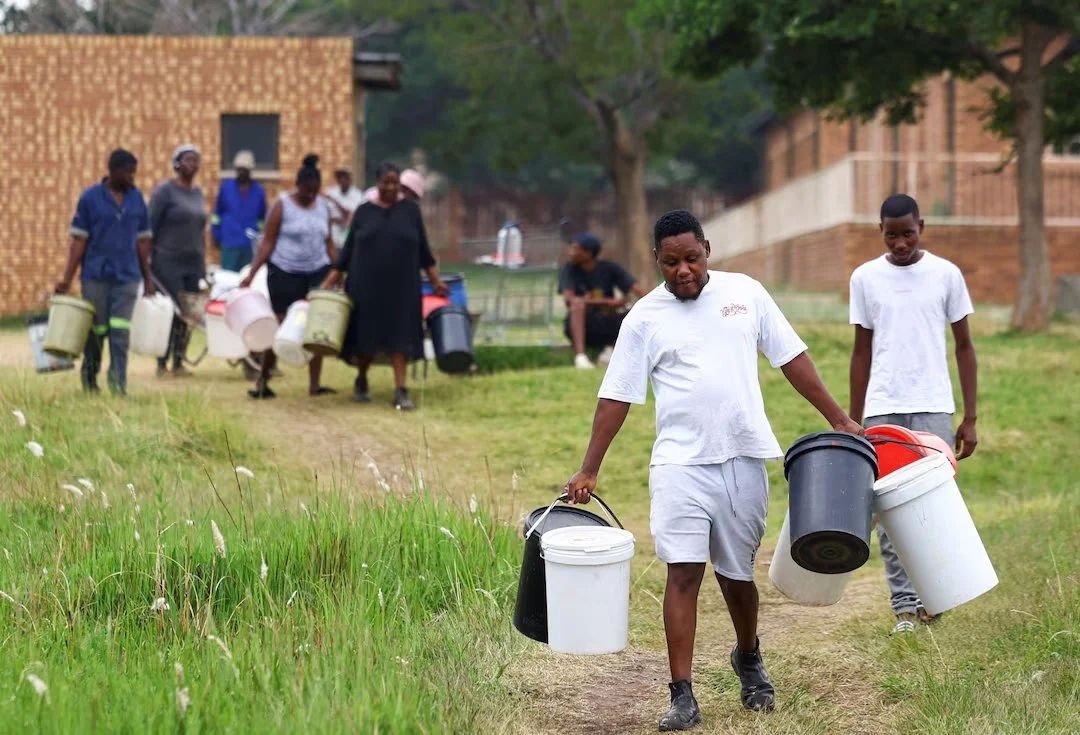
In Johannesburg, residents have learned to measure politics by whether the taps run and the lights stay on. The city has had seven mayors since the 2021 local elections. When South Africans vote this week, on 4 November, the African National Congress (ANC) will face that frustration directly. Residents want councils that collect rubbish, repair roads and account for public money. Having lost its parliamentary majority, the party can no longer rely on its liberation history to carry it. The result will be read well beyond South Africa: across a region where liberation movements still hold or share power, a former liberator is being asked to earn its mandate again.
The ANC won 62.65% of the national vote in 1994 and almost 70% in 2004. Two decades later, in 2024, it fell to 40.18% and entered a Government of National Unity with former rivals, including the Democratic Alliance (DA). Jacob Zuma’s MK Party won 14.58%, while the Economic Freedom Fighters (EFF) took 9.52%.
It’s clear that South Africa is moving beyond ANC political dominance, but ending dominance is not the same as delivering good governance.
The problems are plain in local government. The Auditor-General found that only 39 of 257 municipalities received clean audits for 2024–25. Johannesburg, Tshwane and other metros have repeatedly struggled with political instability and failing services. Opposition-run councils and coalitions have their own records to answer for. Cape Town has a long record of DA government, but housing and apartheid-era spatial inequality remain contested issues there. Voters will judge them on who keeps the water running.
Accountability reaches beyond the council chamber. The Madlanga Commission has heard evidence of alleged criminal influence and political interference in policing and justice, including metropolitan law-enforcement structures. Its recommendations for investigation are not convictions, but the follow-up will test whether institutions can hold the powerful to account.
The votes will be followed by bargaining over control of councils. Research by the Mapungubwe Institute for Strategic Reflection found that 80 of 213 directly elected councils were hung at some point between 2021 and February 2026, passing through 175 administrations. The ANC and DA currently govern together nationally but had no municipal governing coalition in the period examined. The ANC could negotiate locally with the DA, the EFF, MK or smaller parties. Talk of ‘black unity’ will mean little without agreements on budgets, services and appointments. These choices could also reopen tensions within the national Government of National Unity.
MK deserves close scrutiny too. Zuma helped it become KwaZulu-Natal’s largest party in 2024. Internal upheaval quickly followed. It has had eight secretaries-general in less than three years, while Zuma has reshuffled senior officials and appointed his son Duduzane as first deputy president. A party that churns through officials this quickly and promotes a family member offers little proof that it would govern more accountably than the movement it left.
Immigration is also shaping the campaign. The Patriotic Alliance has campaigned on removing undocumented migrants, while ActionSA has advocated closer cooperation with immigration authorities. South Africa’s 2022 census counted about 2.4 million international migrants, or 3.9% of the population. Foreign-born residents are not the same as undocumented migrants, and migration cannot explain the country’s longstanding unemployment crisis. That debate reaches neighbouring countries whose economies and histories remain closely tied to South Africa.
The ANC is also preparing to choose Ramaphosa’s successor as ANC president in 2027. Deputy President Paul Mashatile and Secretary-General Fikile Mbalula feature prominently in the discussion; Patrice Motsepe, Thoko Didiza and Ronald Lamola have also been mentioned, but no field is confirmed. In August, Northern Cape ANC chair Zamani Saul acknowledged that money had previously influenced internal leadership contests. For decades, the ANC presidency offered a near-certain route to the country’s presidency. The loss of its majority changed that. The next party president may need coalition partners to govern nationally.
Municipal results cannot reliably predict who will govern nationally in 2029, because local candidates and turnout shape these contests. They will inform debates about the ANC’s leadership, and which parties can work together.
Zimbabwe offers the starkest regional contrast. South Africa’s ANC lost its majority and negotiated a coalition. Zimbabwe’s ZANU-PF used its parliamentary majority to recently pass Constitutional Amendment No. 3, changing presidential selection from a public vote to election by Parliament and extending terms from five to seven years. The changes are intended to extend President Emmerson Mnangagwa’s tenure to 2030, though legal challenges remain. One liberation party responded to losing its majority by bargaining; the other used the majority to change the rules of the game. The circumstances differ, and each response deserves scrutiny on its own terms. Frelimo in Mozambique, SWAPO in Namibia and the MPLA in Angola all face their own questions about accountability, under different political conditions. Opposition movements face a harder task still: building organizations that are capable of governing once they win.
The generation that fought for liberation earned its place in history. It did not earn the right to govern forever.
Dr. Blessing Vava is a Zimbabwean political analyst and founder and director of the Southern Africa Coalition for Democracy and Accountability. He holds a PhD in Communication Studies from the University of Johannesburg and writes on elections, democratic governance and digital sovereignty.
Disclaimer: The views expressed in this publication do not necessarily reflect the views of Vanguard Africa, the Vanguard Africa Foundation, or its staff.