
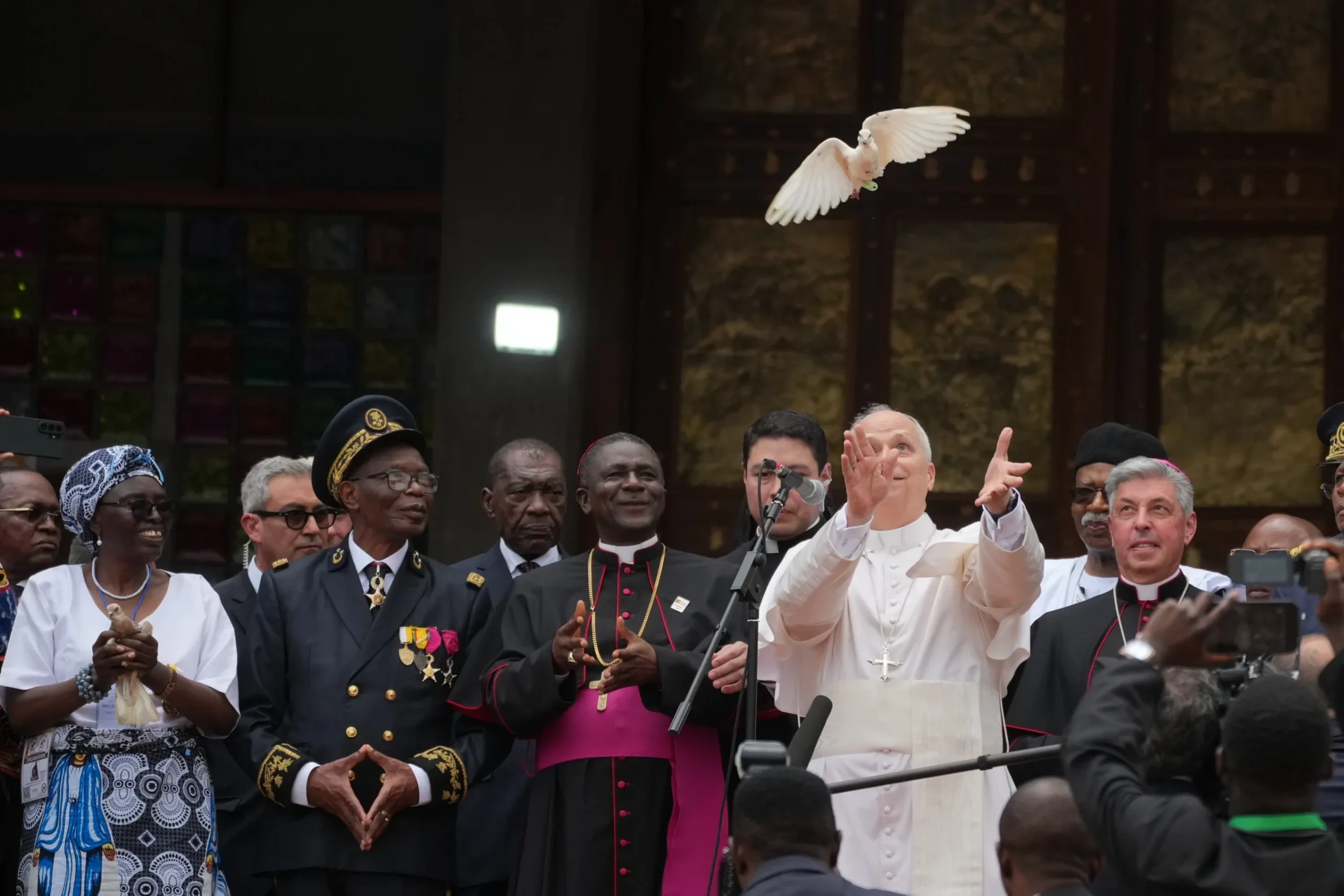
Pope Leo XIV’s four-day visit to Cameroon from April 15-18 was billed by the country’s Catholic leaders as a mission of peace, reconciliation, and justice. Yet from the moment it was announced, the trip became a lightning rod for debate about whether the Vatican could truly break a decade-long cycle of war, repression, and mistrust in Cameroon’s Anglophone regions.
Archbishop Andrew Nkea of Bamenda, president of the National Episcopal Conference, framed the visit as pastoral rather than political, insisting the Pope came as a shepherd, not a mediator. The careful wording was widely seen as damage control. Many Anglophones suspected the visit would lend moral legitimacy to President Paul Biya’s contested 2025 re-election, rather than deliver concrete relief to a war-weary people.
The skepticism was not abstract. Nkea’s trip to the Presidency to secure a formal state invitation fueled accusations of collusion. Critics asked what concessions the Church had offered in exchange. The result was lowered expectations and muted enthusiasm. In a city scarred by years of fighting, only 20,000 faithful turned out for the papal Mass in Bamenda on April 16—significant given the fear and hardship, yet far below what might have been possible in a less polarized time. Heavy military deployments, dread of separatist attacks, and simple economic necessity kept many Catholics at home. For months beforehand, ordinary believers had voiced frustration: without clarity on what the Pope could realistically achieve, why risk the journey?
The belligerents on both sides of the Anglophone conflict understood the global spotlight and moved to shape the narrative. Separatist factions declared a three-day ceasefire, a shrewd public-relations victory that portrayed them as open to dialogue while casting the Biya government as intransigent. The move also spared civilians another forced lockdown that would have been widely defied. The government responded with its own choreography of control. The National Communication Council warned journalists against “irresponsible” coverage and threatened retribution. Accreditation for reporters was tightly restricted, funneling most imagery through the state broadcaster. The Pope’s planned meeting with government officials, diplomats, and civil society at the Yaoundé Conference Centre was abruptly relocated to the Presidency—an unmistakable signal of who was in charge.
Even the optics at the reception in Yaounde carried political weight: the flower girl and boy chosen to greet the Pope were grandchildren of First Lady Chantal Biya. In a nation of ten million Catholics, the selection felt less like pastoral warmth and more like a calculated family portrait.
Yet the Pope refused to be stage-managed. In three stops—Yaoundé, Bamenda, and Douala—he delivered a stern rebuke of systemic oppression while standing within arm’s reach of its architect. He spoke plainly against those who wage war in God’s name and sided unmistakably with ordinary Cameroonians. The message resonated. For many, it was the first time in years that the pain of the Anglophone crisis felt truly heard on the world stage. CNN, BBC, Al Jazeera, France 24, Reuters, AP, and Vatican News poured more coverage into one week than the conflict had received in the previous decade. Cameroonians who had long felt invisible suddenly saw their hospitality, resilience, and cultural pride broadcast globally. The Pope’s chasuble, embroidered with the traditional Bamenda toghu design, became an instant symbol of dignity and belonging.
The visit also exposed deeper truths about the conflict’s anatomy. Ten years of fighting in the former Southern Cameroons—now the Northwest and Southwest regions—have produced no parliamentary debate, no private-member bills, and no serious national conversation, let alone a lasting resolution. Parliament remains a rubber stamp for the ruling party. The root grievance, repeatedly sidelined in public discourse, is the loss of autonomy sealed by the 1972 referendum and the 1984 decree that erased the federal bargain forged at independence. Anglophones argue they were promised a two-state federation, not absorption into a unitary republic dominated from Yaoundé. The government’s pattern has become clear: repeated mediation efforts by Switzerland (2019–2022) and Canada (2023) collapsed because the state refuses meaningful concessions while separatist factions remain woefully fragmented.
The Pope’s visit did not resolve these structural obstacles. The Vatican did not meet separatist leaders directly. Archbishop Nkea’s claim that the visit had “brought development” through freshly tarred roads and an airport renovation provoked outrage; residents saw these as long-overdue rights, not papal gifts. Critics accused the archbishop of turning the trip into a personal vanity project, pointing to lavish spending on the Bamenda Metropolitan Cathedral while the region suffers from the scourge of war and school fees keep rising. Some Catholics and non-Catholics also questioned the Church’s credibility, citing allegations of internal abuse and a perception that the hierarchy too often aligns with state power.
Still, the visit did implant something rare in Cameroon’s political soil: guarded hope. The Pope and Archbishop Nkea announced the formation of a mediation committee tasked with bringing government and separatist representatives to the negotiating table. Its success or failure will ultimately define whether the journey was historic or ceremonial. For now, Bamenda feels seen in a way it has not been for years. The spontaneous hug between the Pope and a little girl who broke protocol to reach him captured the city’s spirit—warm, unscripted, and unwilling to be silenced.
The broader Cameroonian reality remains sobering. Decentralization, promised for decades, has not been realized. Power remains concentrated in unelected hands. Yet the Anglophone crisis carries a distinct historical wound tied to British trusteeship and the broken federal promise. Healing it demands more than symbolism; it requires confronting the currency of this war—autonomy—and convincing those in power to value the lives of their own citizens over concentrated control.
In the end, Pope Leo XIV’s visit succeeded in three measurable ways. First, it focused unprecedented international attention on a forgotten conflict. It gave millions of Cameroonians a moment of collective pride and spiritual consolation. It also forced both warring parties to recalibrate their public postures under the watchful eyes of the world. What it did not achieve—tangible political movement, direct engagement with separatists, or an honest reckoning with the federal question—remains the unfinished work.
Cameroonians are under no illusions. Joy in a minefield is fleeting. Yet for a brief week in April 2026, the world listened. Bamenda stood tall in its traditional robes and in its stubborn hope. Whether that moment becomes the beginning of a genuine peace process now rests with the mediation committee, with the belligerents’ willingness to compromise, and with the Vatican’s determination to keep the pressure on. The people of Cameroon, long hardened by disappointment, are watching and waiting—cautiously, wearily, but still willing to believe that even the smallest crack in a decade of silence might eventually let some light shine through.
Tony Vinyoh is a Cameroonian writer a frequent contributor to Africa Watch. He has numerous by-lines in a range of international and local media outlets, including in the BBC and Fodor’s Travel.
DISCLAIMER: The views expressed in this publication do not necessarily reflect the views of Vanguard Africa, the Vanguard Africa Foundation, or its staff.